
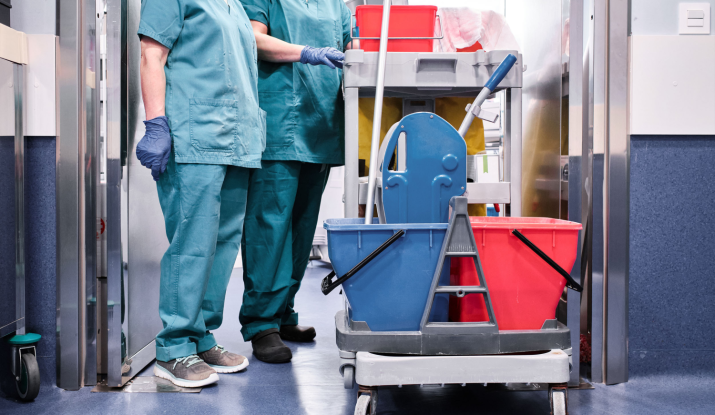
A Melbourne medical centre is cleaned at three speeds: between patients by your clinical team, every evening by your cleaner, and in periodic deep cleans. The RACGP Standards for general practices (5th edition) expect your written infection control policy to cover environmental cleaning of clinical and non-clinical areas. In plain terms, your cleaner’s routine is part of your accreditation evidence, whether you planned it that way or not.
Here is a room-by-room checklist, the product rules that matter and the paperwork worth having ready before your next survey.
Who Cleans What in a Clinic?
Most gaps start with a blurry line between staff and contractors. Draw it clearly:
- Clinical team, during the day: Wipes treatment couches and equipment between patients, manages blood and body fluid spills with a spill kit, and reprocesses instruments.
- Your cleaner, after hours: Cleans every room top to bottom, disinfects high-touch surfaces, cleans toilets, floors and kitchens, and restocks consumables.
- Licensed waste provider: Collects sharps and clinical waste. Your cleaner should never be emptying a sharps container.
Write this split into your infection control policy so a new receptionist, a locum and a relief cleaner all read the same rules.
What to Use? Detergent, Disinfectant, or Both?
Not every surface needs the strongest product in the cupboard. Guidance from the Australian Commission on Safety and Quality in Health Care, which builds on the national infection control guidelines, splits surfaces into two groups:
- Minimally touched surfaces such as floors, walls and blinds are cleaned with detergent.
- Frequently touched surfaces such as door handles, light switches, taps and bench tops get detergent combined with, or followed by, disinfectant when an infection risk calls for it. In community settings like a GP clinic, that call depends on your patient mix, the procedures you perform and any local outbreak.
When a disinfectant is used, it should be a hospital-grade product listed on the Australian Register of Therapeutic Goods, applied for the contact time on its label. Spraying and wiping straight away mostly just moves germs around more evenly.
Daily After-Hours Checklist by Room
Your cleaner should work through these every evening the practice is open:
- Reception and waiting room: Wipe the counter, payment terminal, check-in kiosk and pens. Clean chair arms and seats, and empty bins.
- Consult rooms: Wipe desks, keyboards, phones and door handles. Clean the basin and tapware, damp mop the floor and empty general waste.
- Treatment and procedure rooms: Clean the exterior of trolleys and couches, wipe the basin splashback and damp mop with fresh solution.
- Toilets: Clean and disinfect the toilet, basin, grab rails and baby change table, then restock soap, paper and hand towel.
- Staff kitchen: Clean benches, sink, fridge handles and the microwave inside and out.
- Floors throughout: Vacuum carpet, then mop hard floors from the cleanest room to the dirtiest.
Weekly and Monthly Jobs
- Weekly: Dust high surfaces and vents, clean internal glass, wipe the fridge inside, scrub toilet grout and wash bins.
- Monthly: Spot clean carpets, wash privacy curtains or replace disposable ones by their change date, clean light fittings and wipe down waiting room toys or remove them altogether.
Five Sip-Ups We See in Clinics
We see the same handful of problems whenever we take over a clinic from another cleaner. None of them is expensive to fix.
- One cloth for every room: Colour-coded cloths and mops stop toilet germs from travelling to the consult room benches.
- Fabric waiting room chairs: They absorb spills and cannot be disinfected properly. Wipeable vinyl is the safer choice.
- The forgotten tech: Check-in tablets and payment terminals are touched by every patient but rarely make the cleaning list.
- Dirty water: Mop water reused across the whole practice spreads more than it removes.
- Empty sanitiser: A dry dispenser at reception undoes a lot of good cleaning. Every dispenser should be checked and refilled each night.
What Your Accreditation File Should Hold?
Surveyors look for evidence, not good intentions. Keep these ready in one folder:
- The written cleaning schedule, listing each room, task and frequency.
- Signed or digital cleaning logs for the past few months.
- A product list with safety data sheets and ARTG details for each disinfectant.
- Your cleaner’s colour-coding chart and spill escalation process.
- Records of the infection control training your cleaners have completed.
If your current cleaner cannot produce these within a day, that tells you something.
Download the Free Medical Centre Cleaning Checklist
Our printable checklist covers every room, the daily, weekly and monthly tasks, and a sign-off log you can drop straight into your accreditation folder.
Frequently Asked Questions
-
Who is responsible for cleaning between patients?
Your clinical team. Treatment couches, equipment and procedure surfaces are wiped between patients during the day, because no contract cleaner is on hand every 15 minutes. The after-hours clean resets the whole practice for the next morning.
-
Should our cleaner sign a confidentiality agreement?
Yes. Cleaners work alone after hours around patient files, screens and pathology results. A confidentiality clause in the contract, plus a rule that screens are locked and files are put away each night, protects your patients and your practice.
-
How do we switch cleaners without a gap in cover?
Give notice under your current contract, then use that notice period to book the new cleaner’s walkthrough and induction. Hand over keys and alarm codes in person, and check the first week against the written schedule before you sign off. When you compare quotes, our Melbourne commercial cleaning cost guide shows what a fair rate covers.
Make Your Next Survey the Easy Part
1Eight Facility Services cleans GP clinics, dental surgeries and allied health practices across Melbourne, from Mount Waverley and Oakleigh to Cranbourne. We work to a written schedule, use colour-coded equipment and keep logs ready for your accreditation file. Book a walkthrough and we will show you exactly what your practice needs.